Since CPR-2 revealed that chest compressions were significantly shallower when a supraglottic airway device was used, we decided to test whether including a feedback device could improve chest compression quality.
The results are as surprising as they are disappointing: the feedback was associated with slightly worse chest recoil and failed to improve compression depth.
Reference: Stuby L, Simonet S, Bourgeois L, Thurre D, Suppan L. Feedback devices may not improve chest compression depth during simulated out-of-hospital cardiac arrest: a multicenter randomized controlled trial. Emerg Care J. 2025. doi. 10.4081/ecj.2025.13736
In this multicentre randomized crossover trial, we examined whether early insertion of an i-gel® supraglottic airway — without prior bag-valve-mask ventilation — could enhance ventilation during simulated paediatric out-of-hospital cardiac arrest
No meaningful differences between the two strategies (minute alveolar ventilation difference: 36 ml [95% CI −28 to 99]): whichever device is used, the focus should remain on delivering high-quality ventilations.
Reference: Stuby L, Bourgeois L, Tinembart J-M, Mühlemann E, Thurre D, Siebert JN, Suppan L. Effect of intermediate airway management on ventilation parameters in simulated paediatric out-of-hospital cardiac arrest: a multicentre randomised crossover trial. Swiss Med Wkly. 2025 May 16. doi. 10.57187/s.4079
In the "CPR-5" article, we describe the protocol of a multicenter randomized crossover trial designed to evaluate the impact of airway management strategy (basic vs intermediate) on ventilation parameters in a simulated model of pediatric cardiac arrest.
Reference: Stuby L, Mühlemann E, Jampen L, Thurre D, Siebert JN, Suppan L. Effect of Intermediate Airway Management on Ventilation Parameters in Simulated Pediatric Out-of-Hospital Cardiac Arrest: Protocol for a Multicenter, Randomized, Crossover Trial. Children. 2023; 10(1):148. https://doi.org/10.3390/children10010148
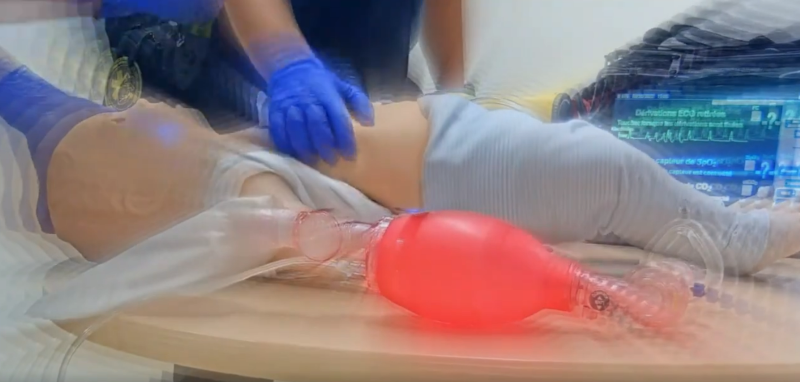 Pediatric cardiac arrests are, fortunately, rare occurences which deeply affect prehospital providers. Most pediatric cardiac arrests are consecutive to hypoxic mechanisms and the European Resuscitation Council (ERC) guidelines advocate the provision of 5 initial rescue breaths prior to initiating chest compressions. Conversely, the American Heart Association (AHA) recommends following the adult resuscitation sequence. We took advantage of the first prehospital research day of the French part of Switzerland to carry out a crossover, randomized trial to evaluate the impact of ERC and AHA guidelines on alveolar ventilation in a simulated model of pediatric cardiac arrest.
Reference: Suppan, L.; Jampen, L.; Siebert, J.N.; Zünd, S.; Stuby, L.; Ozainne, F. Impact of Two Resuscitation Sequences on Alveolar Ventilation during the First Minute of Simulated Pediatric Cardiac Arrest: Randomized Cross-Over Trial. Healthcare 2022, 10, 2451. https://doi.org/10.3390/healthcare10122451
To enhance participant recruitment, a motivational video was broadcasted prior to this research day. You can access this video by clicking here.